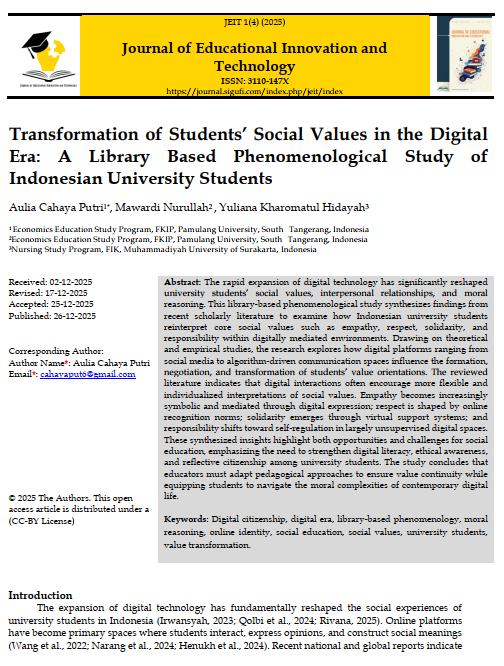
Transformation of Students’ Social Values in the Digital Era: A Library Based Phenomenological Study of Indonesian University Students
Keywords:
Digital citizenship, digital era, library-based phenomenology, moral reasoning, online identity, social education, social values, university students, value transformationAbstract
The rapid expansion of digital technology has significantly reshaped university students’ social values, interpersonal relationships, and moral reasoning. This library-based phenomenological study synthesizes findings from recent scholarly literature to examine how Indonesian university students reinterpret core social values such as empathy, respect, solidarity, and responsibility within digitally mediated environments. Drawing on theoretical and empirical studies, the research explores how digital platforms ranging from social media to algorithm-driven communication spaces influence the formation, negotiation, and transformation of students’ value orientations. The reviewed literature indicates that digital interactions often encourage more flexible and individualized interpretations of social values. Empathy becomes increasingly symbolic and mediated through digital expression; respect is shaped by online recognition norms; solidarity emerges through virtual support systems; and responsibility shifts toward self-regulation in largely unsupervised digital spaces. These synthesized insights highlight both opportunities and challenges for social education, emphasizing the need to strengthen digital literacy, ethical awareness, and reflective citizenship among university students. The study concludes that educators must adapt pedagogical approaches to ensure value continuity while equipping students to navigate the moral complexities of contemporary digital life.
References
Berger, P. L., & Luckmann, T. (1966). The social construction of reality: A treatise in the sociology of knowledge. Anchor Books.
Castells, M. (2010). The rise of the network society (2nd ed.). Wiley-Blackwell.
Chang, A., Rodriguez, S., & Silva, M. (2019). Networked solidarity in digital communities: Reconfiguring collective support in online environments. New Media & Society, 21(11–12), 2534–2553. https://doi.org/10.1177/1461444819851720
Creswell, J. W., & Poth, C. N. (2018). Qualitative inquiry and research design: Choosing among five approaches (4th ed.). SAGE Publications.
Dawson, V., & Henry, A. (2022). Digital citizenship and self-regulation in higher education: Navigating ethics in online environments. Educational Technology & Society, 25(3), 45–60.
ethical decision-making among university learners. Journal of Digital Ethics, 7(2), 67–83.
Goffman, E. (1959). The presentation of self in everyday life. Anchor Books.
Henukh, A., Riandi, R., Setiawan, A., Rochintaniawati, D., Irvani, A. I., & Suba, J. M. (2024). Dynamic Evaluation of the Merdeka Curriculum: Unveiling the Effectiveness of Science Lesson Planning, Implementation and the Response of Junior High School Students. Jurnal Pendidikan Sains Indonesia, 12(3), 683-692.
Hofstede, G. (2011). Cultures and organizations: Software of the mind (3rd ed.). McGraw-Hill.
Husserl, E. (1970). The crisis of European sciences and transcendental phenomenology. Northwestern University Press.
Irwansyah, I. (2023). Meaningful Digital Learning in High School: A Digital Materiality Exploration. International Journal of Learner Diversity & Identities, 30(2).
Kim, J., & Park, G. (2018). Emotional cues in online communication: The rise of symbolic empathy in social media interactions. Computers in Human Behavior, 86, 232–242. https://doi.org/10.1016/j.chb.2018.04.041
Livingstone, S. (2019). Audiences in an age of datafication. Television & New Media, 20(2), 170–183. https://doi.org/10.1177/1527476418811118
Moher, D., Liberati, A., Tetzlaff, J., & Altman, D. G. (2009). Preferred reporting items for systematic reviews and meta-analyses: The PRISMA statement. PLoS Medicine, 6(7), e1000097. https://doi.org/10.1371/journal.pmed.1000097
Moustakas, C. (1994). Phenomenological research methods. SAGE Publications.
Narang, P. B. (2024). Creating opportunities and spaces for social interactions in online contexts: Academic discourse socialization of L2 international graduate students. Computers and Composition, 72, 102849.
O’Neil, J., & Jacobs, M. (2017). Emotional compression and the limits of empathy in digital contexts. Journal of Media Psychology, 29(4), 193–205. https://doi.org/10.1027/18641105/a000203
Qolbi, W. N., Irvani, A. I., & Warliani, R. (2024). The Effectiveness of The Creative Problem Solving (Cps) Model Assisted by Youme (Youtube Media) In Improving the Creative Thinking Skills of High School Students. Pillar Of Physics Education, 17(4), 269-275.
Ribble, M. (2015). Digital citizenship in education (3rd ed.). International Society for Technology in Education.
Rivana, A. (2025). Transforming Teaching Experiences in Online Learning: Voices of Lecturers in Islamic Higher Education. Journal of Educational Innovation and Research, 1(3), 97-104.
Schutz, A. (1972). The phenomenology of the social world. Northwestern University Press.
Shahzad, M. F., Xu, S., Lim, W. M., Yang, X., & Khan, Q. R. (2024). Artificial intelligence and social media on academic performance and mental well-being: Student perceptions of positive impact in the age of smart learning. Heliyon, 10(8). https://doi.org/10.1016/j.heliyon.2024.e29523
Silva, R., & Mendes, V. (2021). Responsibility in digital citizenship: Self-regulation and
UNESCO. (2018). Global citizenship education: Topics and learning objectives. UNESCO Publishing.
Wang, Q., Camacho, I., Jing, S., & Goel, A. K. (2022). Understanding the design space of AI-mediated social interaction in online learning: challenges and opportunities. Proceedings of the ACM on Human-Computer Interaction, 6(CSCW1), 1-26.
We Are Social & Hootsuite, M. (2024). Digital citizenship in education (3rd ed.). International Society for Technology in Education.
Weinstein, E., & James, C. (2021). Leaning into digital dilemmas: How educators’ perspectives can inform new civics education. Teachers College Record, 123(11), 38-56.
Zhang, W., Xu, M., Feng, Y., Mao, Z., & Yan, Z. (2024). The Effect of Procrastination on Physical Exercise among College Students The Chain Effect of Exercise Commitment and Action Control. International Journal of Mental Health Promotion, 26(8), 611–622. https://doi.org/10.32604/ijmhp.2024.052730
Zvereva, E. (2023). Digital ethics in higher education: Modernizing moral values for effective communication in cyberspace. Online Journal of Communication and Media Technologies, 13(2), e202319.
Downloads
Published
Issue
Section
License
Copyright (c) 2025 Journal of Educational Innovation and Technology

This work is licensed under a Creative Commons Attribution 4.0 International License.