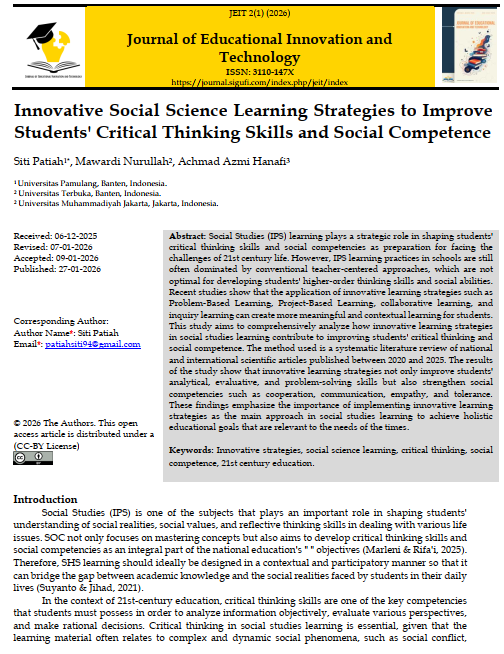
Innovative Social Science Learning Strategies to Improve Students' Critical Thinking Skills and Social Competence
Keywords:
Innovative strategies, social science learning, critical thinking, social competence, 21st century educationAbstract
Social Studies (IPS) learning plays a strategic role in shaping students' critical thinking skills and social competencies as preparation for facing the challenges of 21st century life. However, IPS learning practices in schools are still often dominated by conventional teacher-centered approaches, which are not optimal for developing students' higher-order thinking skills and social abilities. Recent studies show that the application of innovative learning strategies such as Problem-Based Learning, Project-Based Learning, collaborative learning, and inquiry learning can create more meaningful and contextual learning for students. This study aims to comprehensively analyze how innovative learning strategies in social studies learning contribute to improving students' critical thinking and social competence. The method used is a systematic literature review of national and international scientific articles published between 2020 and 2025. The results of the study show that innovative learning strategies not only improve students' analytical, evaluative, and problem-solving skills but also strengthen social competencies such as cooperation, communication, empathy, and tolerance. These findings emphasize the importance of implementing innovative learning strategies as the main approach in social studies learning to achieve holistic educational goals that are relevant to the needs of the times.
References
Azkia, S., Maksum, A., & Usman, H. (2024). Improving critical thinking abilities in social studies learning using problem-based learning assisted by audiovisual media. Jurnal Cakrawala Pendas, 10(1), 45–56.
Bell, S. (2020). Project-based learning for the 21st century: Skills for the future. The Clearing House, 93(2), 42–48.
Booth, A., Sutton, A., & Papaioannou, D. (2021). Systematic approaches to a successful literature review (2nd ed.). Sage.
Braun, V., & Clarke, V. (2021). Thematic analysis: A practical guide. Sage.
Creswell, J. W., & Poth, C. N. (2021). Qualitative inquiry and research design: Choosing among five approaches (4th ed.). Sage.
Darling-Hammond, L., Flook, L., Cook-Harvey, C., Barron, B., & Osher, D. (2020). Implications for educational practice of the science of learning and development. Applied Developmental Science, 24(2), 97–140.
Hmelo-Silver, C. E. (2021). Problem-based learning: What and how do students learn? Educational Psychology Review, 33(2), 1–19.
Huda, M. (2022). Collaborative learning in 21st century social studies education. Journal of Social Education, 14(2), 101–112.
Johnson, D. W., & Johnson, R. T. (2021). Cooperative learning and social interdependence theory. Educational Researcher, 50(4), 1–10.
Ministry of Education, Culture, Research, and Technology. (2022). Guidelines for implementing the Merdeka Curriculum. Ministry of Education, Culture, Research, and Technology.
Kurniawan, D., & Prasetyo, Z. K. (2021). Inquiry-based learning in social studies education. Journal of Social Science Education, 20(3), 45–56.
Lincoln, Y. S., & Guba, E. G. (2020). Naturalistic inquiry. Sage.
Marleni, L., & Rifa'i, R. (2025). Strategies for developing contextual-based social studies learning. RIGGS: Journal of Education and Social Science, 4(1), 33–44.
Nurfitriani, E., & Haifaturrahmah. (2025). Innovative learning strategies to improve 21st-century skills in students. Pendas: Journal of Primary Education, 10(1), 15–27.
OECD. (2021). Global competence in education. OECD Publishing.
Pellegrino, J. W., & Hilton, M. L. (2020). Education for life and work: Developing transferable knowledge and skills. National Academies Press.
Rizaq, A. D. B. (2025). Fostering secondary school students’ critical thinking through group investigation in social studies learning. J-PIPS, 11(1), 66–78.
Sari, D., & Wahyudi, A. (2023). Project-based learning in social studies learning. Journal of Humanities Education, 8(2), 90–102.
Savery, J. R. (2021). Overview of problem-based learning: Definitions and distinctions. Interdisciplinary Journal of Problem-Based Learning, 15(1), 1–8.
Snyder, H. (2020). Literature review as a research methodology. Journal of Business Research, 104, 333–339.
Sugiyono. (2021). Qualitative research methods. Alfabeta.
Suyanto, & Jihad, A. (2021). Becoming a professional teacher: Strategies for improving learning quality. Erlangga.
Trilling, B., & Fadel, C. (2021). 21st century skills: Learning for life in our times. Jossey-Bass.
UNESCO. (2021). Reimagining our futures together: A new social contract for education. UNESCO Publishing.
Widiansesi, & Kamal. (2025). Deep learning approach to improving students’ social competence through social studies learning. Journal of Social Education, 12(1), 55–67.
Xiao, Y., & Watson, M. (2020). Guidance on conducting a systematic literature review. Journal of Planning Education and Research, 40(2), 1–13.
Yuliana, E., & Sapriya. (2022). Strengthening students' social competencies through social studies learning. Journal of Social Studies Education, 9(2), 120–132.
Zubaidah, S. (2020). Critical thinking skills and 21st century education. Indonesian Biology Education Journal, 6(1), 1–9.
Downloads
Published
Issue
Section
License
Copyright (c) 2026 Journal of Educational Innovation and Technology

This work is licensed under a Creative Commons Attribution 4.0 International License.