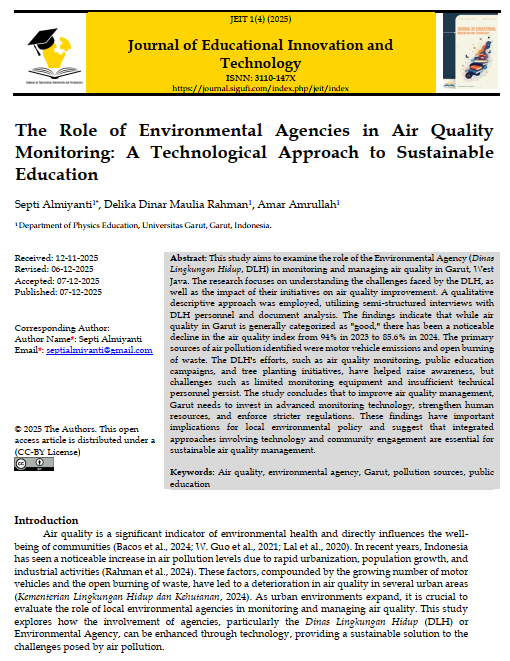
The Role of Environmental Agencies in Air Quality Monitoring: A Technological Approach to Sustainable Education
Keywords:
Air quality, environmental agency, Garut, pollution sources, public educationAbstract
This study aims to examine the role of the Environmental Agency (Dinas Lingkungan Hidup, DLH) in monitoring and managing air quality in Garut, West Java. The research focuses on understanding the challenges faced by the DLH, as well as the impact of their initiatives on air quality improvement. A qualitative descriptive approach was employed, utilizing semi-structured interviews with DLH personnel and document analysis. The findings indicate that while air quality in Garut is generally categorized as "good," there has been a noticeable decline in the air quality index from 94% in 2023 to 85.6% in 2024. The primary sources of air pollution identified were motor vehicle emissions and open burning of waste. The DLH's efforts, such as air quality monitoring, public education campaigns, and tree planting initiatives, have helped raise awareness, but challenges such as limited monitoring equipment and insufficient technical personnel persist. The study concludes that to improve air quality management, Garut needs to invest in advanced monitoring technology, strengthen human resources, and enforce stricter regulations. These findings have important implications for local environmental policy and suggest that integrated approaches involving technology and community engagement are essential for sustainable air quality management.
References
Abdillah, N. (2024). Pencemaran udara di ekosistem perkotaan: Ancaman terhadap biodiversitas dan ekosistem. Spatial Review for Sustainable Development, 1(2), 124–139.
Alamsyah, C. W., Pratama, J. H., & Susetyaningsih, A. (2021). Analisis Ketersediaan Ruang Terbuka Hijau di Kawasan Perkotaan Garut. Jurnal Konstruksi, 19(1), 22–30.
Altassan, A. (2023). Sustainable integration of solar energy, behavior change, and recycling practices in educational institutions: a holistic framework for environmental conservation and quality education. Sustainability, 15(20), 15157.
Amanda, A., Zanah, F., Amrullah, A., & Irvani, A. I. (2025). Attracting Students to Renewable Energy: Direct-Use Geothermal Potential in Garut Regency as a Contextual Resource for Science Education. Journal of Educational Innovation and Technology, 1(3), 116–123.
Amarulloh, R. R., & Irvani, A. I. (2025a). Computational Thinking dalam Pembelajaran Abad ke-21. books.google.com.
Amarulloh, R. R., & Irvani, A. I. (2025b). Metode Penelitian Kuantitatif dalam Pendidikan: Sebuah Panduan Praktis. PT. Sigufi Artha Nusantara.
Bacos, I. B., Veres, C., Curta, P. A., Gabor, M. R., & Oltean, F. D. (2024). Impacts of Air Pollution on Community Well-Being in the Tourism Sector: A Comprehensive Literature Review. Sustainability, 16(23), 10752.
Berigüete, F. E., Santos, J. S., & Rodriguez Cantalapiedra, I. (2024). Digital revolution: Emerging technologies for enhancing citizen engagement in urban and environmental management. Land, 13(11), 1921.
Caputo, F., Magliocca, P., Canestrino, R., & Rescigno, E. (2023). Rethinking the role of technology for citizens’ engagement and sustainable development in smart cities. Sustainability, 15(13), 10400.
Chen, J., Chen, S., Fu, R., Li, D., Jiang, H., Wang, C., Peng, Y., Jia, K., & Hicks, B. J. (2022). Remote sensing big data for water environment monitoring: Current status, challenges, and future prospects. Earth’s Future, 10(2), e2021EF002289.
Chibueze Izah, S. (2025). Smart Technologies in Environmental Monitoring: Enhancing Real-Time Data for Health Management. In Innovative Approaches in Environmental Health Management: Processes, Technologies, and Strategies for a Sustainable Future (hal. 199–224). Springer.
Creswell, J. W., & Creswell, J. D. (2017). Research design: Qualitative, quantitative, and mixed methods approaches. Sage publications.
Dinas Lingkungan Hidup Kabupaten Garut. (2024). Laporan akhir pemantauan kualitas uadara di Kabupaten Garut tahun 2024. Garut: Dinas Lingkungan Hidup Kabupaten Garut bekerja sama dengan PT. Marga Bhuana Jaya.
Fadhullah, W., Imran, N. I. N., Ismail, S. N. S., Jaafar, M. H., & Abdullah, H. (2022). Household solid waste management practices and perceptions among residents in the East Coast of Malaysia. BMC public health, 22(1), 1.
Fau, M. A. F., & Akliyah, L. S. (2013). Penilaian Kualitas Lingkungan dan Fasilitas Ekowisata Darajat Pass Kabupaten Garut. Jurnal Perencanaan Wilayah dan Kota, 13(1).
Guo, J., Chai, G., Song, X., Hui, X., Li, Z., Feng, X., & Yang, K. (2023). Long-term exposure to particulate matter on cardiovascular and respiratory diseases in low-and middle-income countries: A systematic review and meta-analysis. Frontiers in Public Health, 11, 1134341.
Guo, W., Chen, L., Fan, Y., Liu, M., & Jiang, F. (2021). Effect of ambient air quality on subjective well-being among Chinese working adults. Journal of Cleaner Production, 296, 126509.
Husen, A., Purwandari, D. A., Devy, A. Z., & Ginting, N. R. B. (2025). Organizational Culture in Waste Collection Fleet Management: Implications for Operational Efficiency and Urban Environmental Impact. Jurnal Indonesia Sosial Teknologi, 6(7).
Kousar, S., Afzal, M., Ahmed, F., & Bojnec, Š. (2022). Environmental awareness and air quality: The mediating role of environmental protective behaviors. Sustainability, 14(6), 3138.
Kumari, S., Choudhury, A., Karki, P., Simon, M., Chowdhry, J., Nandra, A., Sharma, P., Sengupta, A., Yadav, A., & Raju, M. P. (2025). Next-Generation Air Quality Management: Unveiling Advanced Techniques for Monitoring and Controlling Pollution. Aerosol Science and Engineering, 1–22.
Lal, R. M., Das, K., Fan, Y., Barkjohn, K. K., Botchwey, N., Ramaswami, A., & Russell, A. G. (2020). Connecting air quality with emotional well-being and neighborhood infrastructure in a US city. Environmental Health Insights, 14, 1178630220915488.
Nyayapathi, P. P., Namuduri, S., & Kolli, S. K. (2025). A comprehensive review of vertical profiling of ambient air quality-particulate matter and its impacts on climatic & environmental health. Air Quality, Atmosphere & Health, 1–27.
Rahman, R. A., White, B., & Ma, C. (2024). The effect of growth, deforestation, forest fires, and volcanoes on Indonesian regional air quality. Journal of Cleaner Production, 457, 142311.
Sharma, R., Kurmi, O. P., Hariprasad, P., & Tyagi, S. K. (2024). Health implications due to exposure to fine and ultra-fine particulate matters: A short review. International Journal of Ambient Energy, 45(1), 2314256.
Sun, C., Xu, S., Yang, M., & Gong, X. (2022). Urban traffic regulation and air pollution: A case study of urban motor vehicle restriction policy. Energy Policy, 163, 112819.
Wallington, T. J., Anderson, J. E., Dolan, R. H., & Winkler, S. L. (2022). Vehicle emissions and urban air quality: 60 years of progress. Atmosphere, 13(5), 650.
Zhang, X., Han, L., Wei, H., Tan, X., Zhou, W., Li, W., & Qian, Y. (2022). Linking urbanization and air quality together: A review and a perspective on the future sustainable urban development. Journal of Cleaner Production, 346, 130988.
Downloads
Published
Issue
Section
License
Copyright (c) 2025 Journal of Educational Innovation and Technology

This work is licensed under a Creative Commons Attribution 4.0 International License.