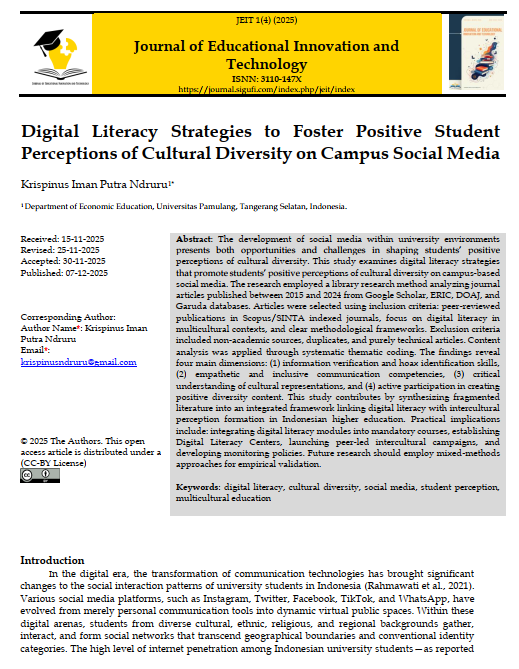
Digital Literacy Strategies to Foster Positive Student Perceptions of Cultural Diversity on Campus Social Media
Keywords:
digital literacy, cultural diversity, social media, student perception, multicultural educationAbstract
The development of social media within university environments presents both opportunities and challenges in shaping students’ positive perceptions of cultural diversity. This study examines digital literacy strategies that promote students’ positive perceptions of cultural diversity on campus-based social media. The research employed a library research method analyzing journal articles published between 2015 and 2024 from Google Scholar, ERIC, DOAJ, and Garuda databases. Articles were selected using inclusion criteria: peer-reviewed publications in Scopus/SINTA indexed journals, focus on digital literacy in multicultural contexts, and clear methodological frameworks. Exclusion criteria included non-academic sources, duplicates, and purely technical articles. Content analysis was applied through systematic thematic coding. The findings reveal four main dimensions: (1) information verification and hoax identification skills, (2) empathetic and inclusive communication competencies, (3) critical understanding of cultural representations, and (4) active participation in creating positive diversity content. This study contributes by synthesizing fragmented literature into an integrated framework linking digital literacy with intercultural perception formation in Indonesian higher education. Practical implications include: integrating digital literacy modules into mandatory courses, establishing Digital Literacy Centers, launching peer-led intercultural campaigns, and developing monitoring policies. Future research should employ mixed-methods approaches for empirical validation.
References
Association of Indonesian Internet Service Providers. (2023). Indonesia Internet Profile 2023. APJII. https://survei.apjii.or.id/survei
Andriani, W., Subandowo, M., Karyono, H., & Gunawan, W. (2024). The urgency of multicultural education through social media in shaping students’ character in the digital era. Syntax Literate: Indonesian Scientific Journal, 9(3), 1862–1874. https://doi.org/10.36418/syntax-literate.v9i3.15646
Anurogo, D., Al-Mustafa, A. S., La Ramba, H., Putri, N. D., Pramono, U. M. P., Salsabila, A., & Ilmi, A. A. J. (2023). Digital literacy 5.0 to enhance multicultural education. Multicultural Islamic Education Review, 1(2), 95–104. https://doi.org/10.23917/mier.v1i2.3414
Fakhri, M. N., Zakiah, F. N., & Novia, L. (2025). Digital literacy and cultural awareness as solutions to atemporality challenges in intercultural communication. Al-Jamahiria: Journal of Communication and Islamic Da’wah, 3(1), 89–102. https://doi.org/10.30983/al-jamahiria.v3i1.9841
Harahap, T. R., Mutmainnah, N., Irwansyah, K., & Kurnia, N. (2025). More media-oriented than literacy-focused: Problematizations in Indonesia’s digital literacy policy. Journal of Communication, 19(2), 275–296. https://doi.org/10.20885/komunikasi.vol19.iss2.art6
Henukh, A., Irvani, A. I., Setiawan, A., Seme, E. M., & Raja, N. R. L. (2025). AI and Transformative Learning in Higher Education: A Systematic Literature Review and Bibliometric Insights. Journal of Teaching and Learning, 19(4), 233-261.
Huang, G., Jia, W., & Yu, W. (2024). Media literacy interventions improve resilience to misinformation: A meta-analytic investigation of overall effect and moderating factors. Communication Research, 52(1), 1–28. https://doi.org/10.1177/00936502241288103
Gelovani, S. (2023). Polarization on social media and beyond: a comparative study of how social media influence inter-group attitudes (Doctoral dissertation, Technische Universität München).
Irvani, A. I., & Anisah, A. S. (2024). Infrastructure and Innovation: Rethinking Digital Literacy for K-12 Learners. Sinergi International Journal of Education, 2(4), 253-264.
Islam, A. K. M. N., Laato, S., Talukder, S., & Sutinen, E. (2020). Misinformation sharing and social media fatigue during COVID-19: An affordance and cognitive load perspective. Technological Forecasting and Social Change, 159, 120201. https://doi.org/10.1016/j.techfore.2020.120201
Jannah, S. M., Hermawati, P. K., Sujaryanto, H., & Nuryadi, M. H. (2025). The role of citizenship awareness transformation in the digital globalization era in building a tolerant society: A case study of responses to racism issues on social media. Journal of Indonesian Education and Citizenship, 2(2), 242–257. https://doi.org/10.61132/jupenkei.v2i2.496
Rahmawati, A., & Sujono, F. K. (2021). Digital communication through online learning in Indonesia: Challenges and opportunities. Jurnal Aspikom, 6(1), 61-76.
Rusmawaty, B., Nawawi, M., Nurhamni, N., Meilani, R., & Safitri, D. (2024). Digital literacy: Preventing hoaxes and hate speech in dormitory students at IPMIL Raya Palu. Journal of Community Service for the Nation, 3(1), Article 2134. https://doi.org/10.59837/jpmba.v3i1.2134
Rusydiyah, E. F., Purwati, E., & Prabowo, A. (2020). How to use digital literacy as a learning resource for teacher candidates in Indonesia. Cakrawala Pendidikan, 39(2), 305–318. https://doi.org/10.21831/cp.v39i2.30551
Saddam, S., Hardati, P., Tanggur, F. S., & Mirzachaerulsyah, E. (2025). Integration of digital culture values through Pancasila Education course for strengthening students’ communication ethics. Social Horizon: Journal of Social Education, 12(1), 13–29. https://doi.org/10.31571/sosial.v12i1.8602
Setara Institute for Democracy and Peace. (2023). Indonesia Student Tolerance Index 2023. Setara Institute. https://setara-institute.org
Sholikhah, H. A., Ernalida, E., Izzah, I., Putri, A. Y., & Nuzula, K. (2025). From language learning to multiliteracies: Exploring digital literacy and student skill development in Indonesian for foreign learners. Proceedings of the International Conference on Education, 605–613.
Sidi, B. A. (2020). Unity and diversity: National identity and multiculturalism in Indonesia (Doctoral dissertation, University of Otago).
Smith, E. E. (2024). Building critical digital literacies for social media through educational development. Journal of Contemporary Issues in Education, 19(2), 56–78. https://journals.library.ualberta.ca/jcie/index.php/JCIE/article/view/29599
Sogalrey, F. A. M., Safitri, F., Tijow, M. A., Sembiring, D. A. K., & Risamasu, P. E. G. (2024). Digital literacy research in education: Trends and insights. Journal of Educational Studies: Research and Literature Review in Teaching and Learning, 10(3). https://doi.org/10.33394/jk.v10i3.12490
Utomo, P., & Prayogi, F. (2020). Digital literacy: Social behavior and interactions of Bengkulu society in instilling diversity values through social media dissemination. Indonesian Journal of Social Science Education.
Ward, C., & Gale, J. (2025). Diversity-receptiveness in higher education: Perceived multicultural norms, well-being and attitudes toward international students. Social Psychology of Education, 28(1), 1–28. https://doi.org/10.1007/s11218-024-09979-z
Yanti, N., Mulyati, Y., Sunendar, D., & Damaianti, V. (2021). Digital literacy levels of Indonesian university students. Diksa: Indonesian Language and Literature Education, 7(1), 61–70. https://doi.org/10.33369/diksa.v7i1.15642
Downloads
Published
Issue
Section
License
Copyright (c) 2025 Journal of Educational Innovation and Technology

This work is licensed under a Creative Commons Attribution 4.0 International License.